It’s the end of June. For some people, the holidays have already begun, while for others they are just around the corner. Either way, we have two summer months ahead of us.
Many people are eagerly counting down the days, and I keep hearing the same phrases around me: “Just a few more days until my holiday.” “I’ll finally get some rest on holiday.” “I just need to get through the next few weeks.” I stopped and reflected on these words a few years ago because I think many of us can relate to them. They made me wonder: Do I really want to arrive at my holiday exhausted and running on empty? Can we truly recharge our batteries in just two weeks a year? Or are holidays simply a break from a life that we’ll soon return to?
That led me to another question: What do I actually want holidays to be?
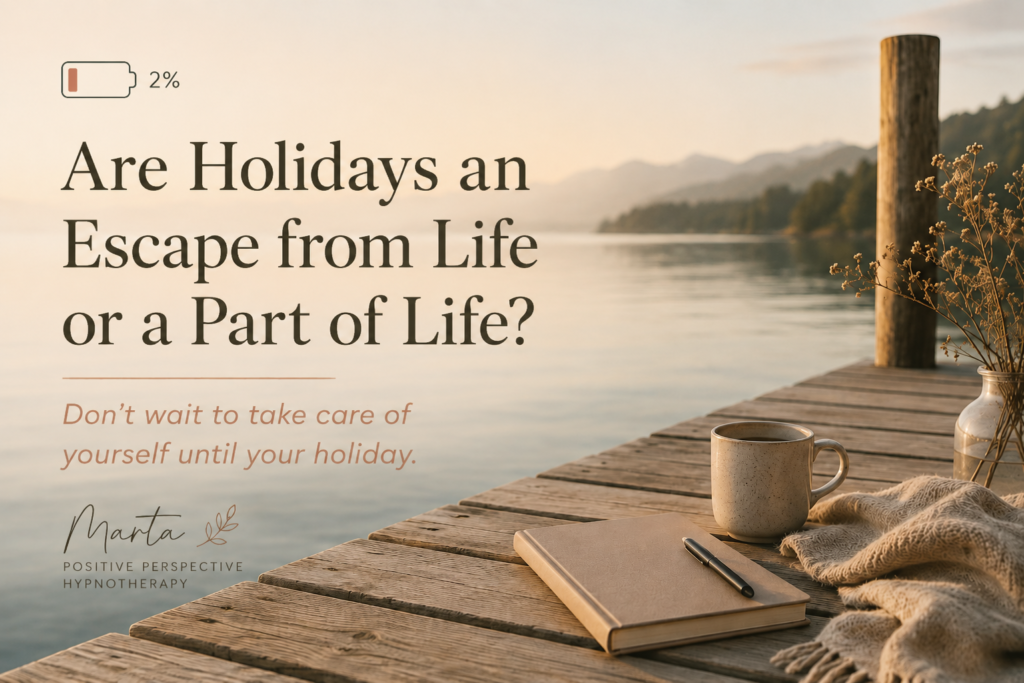
I came to the conclusion that when we arrive at them completely drained and treat them as our only opportunity to recover, they become nothing more than an emergency charger – a power bank we reach for when the battery is almost dead. Imagine a phone operating for months on just 2-5% battery. A low-battery warning keeps appearing on the screen. Apps start freezing. The system becomes slower and less responsive. The phone still functions, but not in the way it was designed to.
Now imagine plugging that phone into a charger for two weeks. Would the battery recharge? Of course. But what happens afterwards if we go back to using it in exactly the same way?
Most likely, the battery will start draining again before long. Not because the charger failed, but because we returned to the same habits that caused the constant depletion in the first place. And that’s why the real issue isn’t the charger – it’s how the phone is being used. Sometimes I think we treat ourselves in much the same way.
For most of the year we rush from one thing to another. We answer messages, tick tasks off our lists and try to keep up with endless responsibilities. We sleep too little. We postpone rest until later. We push ourselves to the maximum while giving ourselves the minimum opportunity to recharge. Then we hope that two weeks away will somehow fix everything.
It’s a bit like fully charging a phone only once a year and expecting it to perform at its best for the remaining months.
Do We Actually Rest During Holidays?
This may sound a little controversial, but I’m not sure we always do. Modern holidays often involve airports, travel plans, reservations, sightseeing, activities, taking photos, checking reviews, searching for the best places to visit and feeling pressure to make the most of every moment. The surroundings change, but the mind keeps working. Only the tasks are different. We’re still planning, organising and making decisions. Our brains and bodies are still operating in “doing mode.”
When Does the Brain Really Rest?
Through my work with clients, I’ve often noticed that people confuse pleasure with recovery. And they’re not always the same thing. Our brains don’t necessarily rest because we’re doing enjoyable things. The brain rests when it can stop being constantly on alert. When it doesn’t have to make hundreds of decisions, analyse, plan, predict or solve problems. When it doesn’t have to achieve something or prove anything. Just as a phone needs time to cool down and avoid overheating, our minds need moments when they don’t have to be constantly in use.
Perhaps This Is Where Something Important Lies
When we go on holiday, it’s often not just the location that changes. The way we experience our days changes too. We sleep longer. We take walks with no destination. We eat more slowly. We watch the sunset. We talk. We sit outside. We stop checking emails every five minutes. We become more present. And perhaps that’s the most important question I’d like to leave you with:
Not “How can I plan a better holiday?” But: “What do I do on holiday that is missing from the rest of my year?”
What If Everyday Life Included 10% More Holiday?
I’m not talking about exotic destinations. Life looks different for everyone, and not everyone can take a holiday whenever they want. But perhaps we can bring a small piece of that holiday feeling into everyday life. I’m talking about being more present. What would change if your daily life included just 10% more of what holidays give you? Maybe you’d notice more sunsets. Maybe you’d take one walk without your phone. Maybe you’d enjoy a slower breakfast. Maybe you’d spend an evening without notifications. Maybe you’d allow yourself thirty minutes without the need to be productive. Maybe you’d sleep a little more and rush a little less. Nothing dramatic.
Yet perhaps these small moments are the real battery chargers. Maybe that’s the point. Not that two weeks a year should be extraordinary, but that everyday life shouldn’t require us to constantly rescue ourselves with holidays. If you’re counting down the days until your next break, perhaps it’s not simply a sign that you need a holiday. Perhaps it’s a sign that your everyday life is asking for more space to rest, recover and simply be a human being rather than someone whose value is measured only by what they accomplish.
Don’t wait until your holiday to start taking care of yourself.
In Summary
I’m not writing this to discourage holidays. Quite the opposite. Holidays matter. They help us breathe, gain perspective and rest. I’m writing this to highlight that we don’t have to arrive at them completely exhausted. It’s not just about holidays. It’s about the everyday life that makes up most of our lives. By bringing small pieces of “holiday” into our daily routines, we recharge our batteries before they reach empty.
Perhaps the greatest value of a holiday isn’t the trip itself. Perhaps its greatest value is showing us what we need more of throughout the rest of the year: more presence, more calm, more rest and more life between holidays.
And finally, speaking a little provocatively, I sometimes think we take better care of our phones than we do of ourselves. We charge them regularly. We update them. We protect them from overheating. We react immediately when the battery drops to a few percent.
Let’s not forget to do the same for ourselves.
As I write this blog on a very hot English summer day, I wish you a great summer holiday that is not only a change of scenery, but also an opportunity for genuine rest and recovery – the kind of rest that you can bring back with you into everyday life.
Marta

 English (UK)